

ChatGPT Ads in Belgium: how it works and what we're learning from our first test
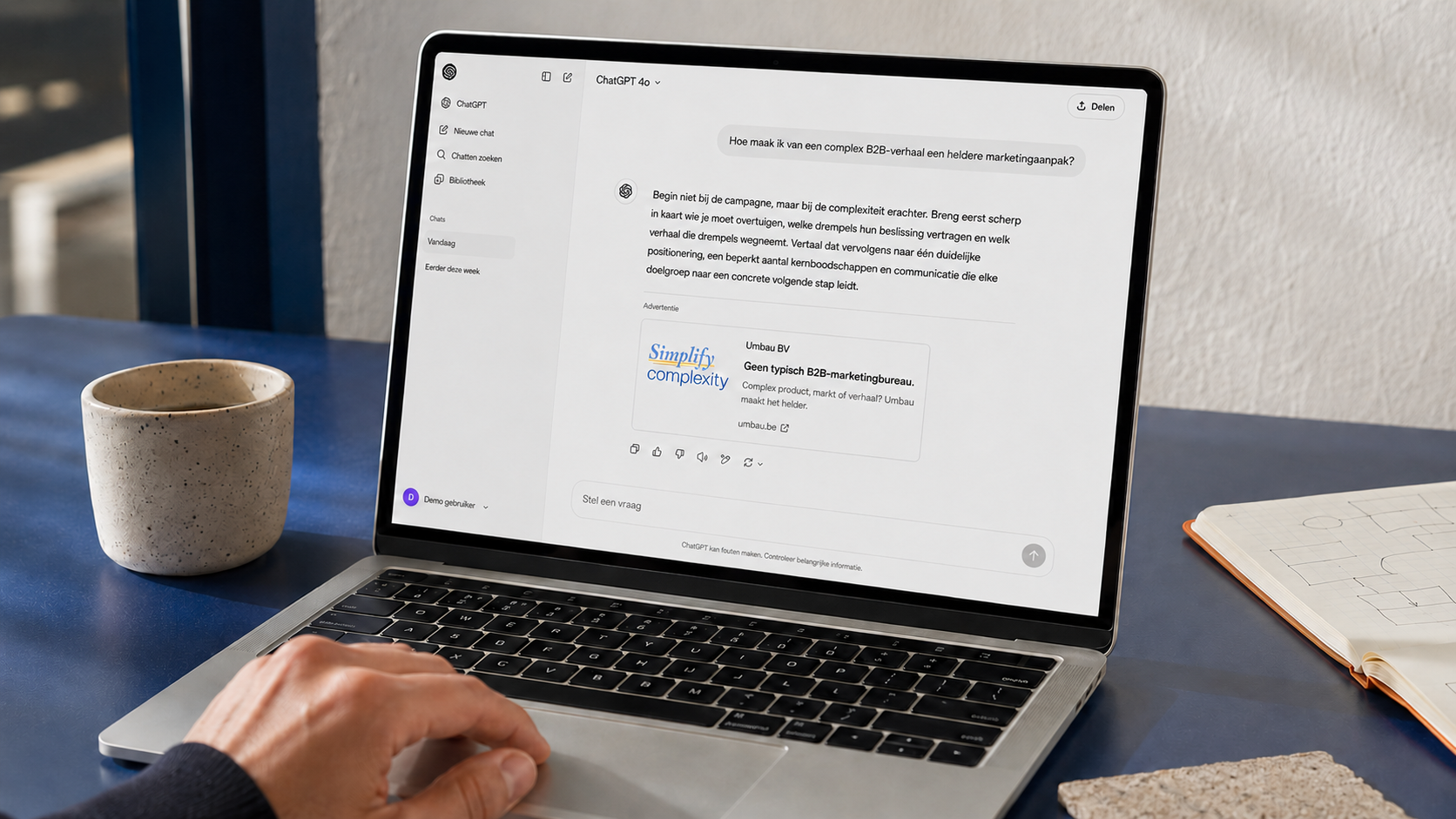
On 1 September 2026, a new campaign went live at Umbau. Not on Google. Not on LinkedIn. Not on Meta. In ChatGPT.
In recent weeks we'd noticed the same question coming up strikingly often from clients: "Can we already advertise in ChatGPT?"
As of this week, the answer is a clear yes for Belgian companies too. OpenAI further rolled out its self-service Ads Manager to Europe in late August, and now officially lists Belgium as an available market.
Whether ChatGPT Ads will immediately become the next big thing? No idea. But that's exactly why we want to be early. Not to be the first to talk about it, but to understand as quickly as possible how the channel actually works, where the opportunities lie, and which companies it could be interesting for.
So we started where we like to start at Umbau: with ourselves.
Short answer: ChatGPT Ads have been available to Belgian advertisers via Ads Manager since September 2026. Unlike Google Ads, they don't work primarily with keywords, but with conversational context, intent, landing pages, ad copy and context hints. Umbau has been testing the channel itself since 1 September; after the first 24 hours we saw 8,577 impressions, 97 clicks and a 1.13% CTR.
What are ChatGPT Ads?
ChatGPT Ads are advertisements that can appear separately from the regular ChatGPT answer when someone uses ChatGPT to look for information, explore options, compare products or services, or prepare a decision. Ads don't influence ChatGPT's answer, and advertisers don't get access to users' conversations. OpenAI uses the context and intent within a conversation to determine which ads might be relevant.
At first glance, that looks like just a new ad placement. But the way you become relevant there is fundamentally different.
ChatGPT Ads don't work like Google Ads
With Google Search, a campaign traditionally starts with a question like: "Which keywords do we want to be found for?"
With Meta or LinkedIn, that becomes more: "Which audience do we want to reach?"
With ChatGPT Ads, the question becomes: "In which situation or decision context is our offering useful?"
That difference matters. A classic Google search could be: "B2B marketing agency Mechelen".
A conversation with ChatGPT can be much richer: "We're a technical B2B company with 80 employees. Marketing is fragmented today, and sales feels too few quality leads are coming in. We're looking for an agency that can think strategically but also execute. What should we look out for?"
That already contains the problem, the company situation, the need, the buying criteria and the intent, all in one conversation. And it's precisely that context the ad platform tries to understand. OpenAI describes the main relevance signals as including the context and intent of the current conversation, the ad copy, the landing page, and context hints added by the advertiser.
No keywords, but context hints
One of the most striking parts of ChatGPT Ads is context hints. These are descriptions that give OpenAI extra information about:
- the interests and pain points of your target audience;
- the kinds of situations or questions in which your offering is relevant;
- characteristics of companies or roles for which your solution is valuable;
- the type of decision someone is trying to make at that moment.
A context hint for Umbau, for example, wouldn't be: "marketing agency".
But rather: "B2B companies that notice their marketing is fragmented and are looking for an agency that can combine strategy and execution."
Or: "Marketing managers comparing different agencies for a complex B2B product where classic lead generation isn't working well enough."
Important: these are not keywords in disguise. You can't say: "show our ad when someone types this exact prompt." OpenAI explicitly states that context hints are not exact-match targeting rules and don't guarantee display for a specific sentence or conversation. That has an important consequence: the focus shifts from keyword research to intent research.
Our first ChatGPT Ads test in Belgium
We didn't want to wait until a hundred case studies were available. So we set up a simple test for Umbau itself. Not with a large budget, and not with the illusion that we'd understand how the algorithm works after just one day. But with a clear structure that let us start seeing differences.
We worked with several ad groups built around different contexts and intents:
- a group around general awareness of B2B marketing challenges;
- a group focused on comparing agencies and approaches;
- a group with a concrete, action-oriented intent (looking for a partner);
- a group with local targeting around Mechelen and Antwerp.
We also tested different kinds of ads: from more classic contact-focused copy to ads that offer substantive value first. And of course, we set up tracking beforehand. Because a click alone says remarkably little.
Our first results after 24 hours
Conclusions after one day are dangerous. But the first signals are interesting enough to share.
1. 8,577 impressions and 97 clicks
After roughly 24 hours the counter stood at 8,577 impressions, 97 clicks and a CTR of 1.13%, for just over €100 in ad spend. For a first Belgian B2B test: above our expectations.
That's not a business case yet. For that we ultimately want to know who clicks, who converts and which leads are genuinely interesting. And that's where it gets more interesting.
2. Almost three quarters of the identifiable companies matched our ICP
Through LeadInfo we could identify a number of organisations that landed on our website after an ad. Of those companies, almost three quarters fell straight within our ideal customer profile.
Here too: too little volume for bold claims. But for B2B we find this far more important than CTR alone. Ten clicks from relevant organisations can ultimately be more interesting to us than a hundred cheap clicks from people who could never become clients.
3. Useful seems to work better than commercial
One of the first patterns we're seeing, we find particularly interesting in substance. Ads that offer someone substantive value are currently performing about 25% better than ads pointing straight to "contact us." That aligns with what's also visible in early international tests. In a small published test by Propellic, for example, informational creative achieved a higher CTR than a more bottom-of-funnel commercial variant. That's not a universal benchmark, but it is an interesting hypothesis worth investigating further.
And actually, it makes sense. Someone asking ChatGPT: "How can we make our B2B marketing more professional?" may be far more receptive to "See our approach to complex B2B marketing" than to "Book a meeting now."
Useful beats pushy may well become an important creative rule of conversational advertising. We're continuing to test this.
4. Concrete intent is performing strongest so far
Our most action-oriented ad group is currently achieving the highest CTR. That's the group that doesn't start from "who is our audience?", but from: "in what situation does someone find Umbau relevant?" For example, when someone:
- has just taken on responsibility for marketing and is looking for a partner;
- is unhappy with the results of their current agency;
- is looking for extra support alongside an internal marketing team;
- wants to launch a new product or service and needs marketing support for it.
Local targeting around Mechelen and Antwerp is also delivering good signals so far. Again: no conclusion yet. But reason enough to increasingly structure our campaign around situations and jobs-to-be-done in the coming weeks.
The biggest surprise: remarkably few dials to turn
Anyone opening Ads Manager for the first time with years of Google, Meta or LinkedIn experience under their belt may experience a bit of withdrawal. There's simply much less to adjust.
That's deliberate: advertisers don't get access to private conversations, chat history, memories or individual personal data of ChatGPT users. The targeting options are therefore, for now, far more limited than performance marketers are used to. And that's exactly why we think a different kind of expertise becomes more important.
The heavy lifting happens before you click Publish. You need to understand:
- in which conversations and situations your offering is relevant;
- which context hints correctly describe those situations;
- which landing page best matches that intent;
- which ad copy and tone suit a conversational, researching user.
That's less media buying. And much more strategy, customer insight, intent mapping and copywriting.
Can you target audiences in ChatGPT Ads?
To some extent. OpenAI has developed functionality for first-party audiences, but the options differ per market and privacy regime. In the European Economic Area, the ad experience is also more restrictive in terms of personalisation than in some non-European markets. For our Belgian tests, we therefore currently regard ChatGPT Ads mainly as contextual-first advertising. In other words: not first "who is this person?", but "what is this person trying to solve right now?" That's a fairly fundamental difference.
What campaign formats are possible?
ChatGPT Ads currently supports several buying and optimisation models, including:
- Reach — via CPM, for visibility and impressions;
- Clicks — via CPC, for traffic and initial learnings;
- Conversions — via oCPC / conversion optimisation, to optimise towards downstream actions.
OpenAI also offers a Pixel and Conversions API for measuring conversions.
For a new B2B test, we wouldn't put everything on conversion optimisation straight away. First we want to gather enough reliable data on: context → ad → click → website behaviour → lead quality. Only after that does it make sense to ask an algorithm to automatically optimise towards conversions.
What does advertising on ChatGPT cost?
There's no sensible universal answer to that yet today. OpenAI supports CPC and CPM. For manual CPC campaigns, OpenAI currently mentions an initial maximum bid of roughly 3 to 5 dollars per click as a starting point. But early real-world data varies enormously. There are published campaigns with CPCs under two dollars, campaigns around four to five dollars, and tests heading towards ten dollars. That's exactly why we're not selling a generic benchmark today. ChatGPT Ads simply hasn't been around long enough to say: "A good ChatGPT Ads campaign always gets X% CTR and costs Y euros per lead." Anyone claiming that today knows more than the available data allows.
Which companies could find ChatGPT Ads interesting?
Our hypothesis is that the channel could become especially interesting for companies with a considered purchase. These are products and services where customers don't decide on impulse, but first:
- research extensively;
- compare multiple providers or solutions;
- ask colleagues or other stakeholders for input;
- go through a longer consideration period before making a decision.
Think of, for example: complex B2B services, software and technology, professional services, industrial products, mobility solutions, larger capital goods and specialised business solutions.
That aligns with how OpenAI itself positions the ad moment: reaching users while they explore, compare and make decisions. For an impulse product at €7, Meta may for now make more sense. For a customer spending weeks gathering information for a €50,000 investment? Then conversational intent suddenly becomes very interesting.
Is ChatGPT Ads a replacement for Google Ads?
No. And we definitely wouldn't position it that way today. Google Search is particularly strong when someone expresses an explicit, existing question: "marketing agency Mechelen." ChatGPT can sit much earlier in the decision process: "Why isn't our marketing generating enough leads?", "What are the pros and cons of an in-house marketing team versus an agency?", "How do I choose a marketing agency for a technical B2B company?" That means ChatGPT Ads could become an interesting additional layer alongside Google, LinkedIn and Meta, not necessarily a replacement for them.
A highly simplified comparison:
- Starting point — Google Search: search term. Meta/LinkedIn: audience. ChatGPT Ads: conversation context.
- Strong at — Google Search: demand capture. Meta/LinkedIn: discovery/targeting. ChatGPT Ads: research & consideration.
- Central question — Google Search: "What is someone searching for?" Meta/LinkedIn: "Who do we want to reach?" ChatGPT Ads: "What is someone trying to solve?"
- Main work — Google Search: keywords & bidding. Meta/LinkedIn: audience & creative. ChatGPT Ads: intent & context.
That last point is, for us, the most interesting one for now.
From SEO and SEA to GEO and ChatGPT Ads
Another interesting parallel is emerging. With Google, companies have learned there are two main ways to become visible: SEO (being found organically) and SEA (paying for visibility). Something similar is gradually emerging with AI. On one hand, you can pay to become visible with ChatGPT Ads. On the other hand, you want ChatGPT, Gemini, Perplexity and other AI systems to find, understand and possibly use your brand, expertise and content organically in their answers. That's where GEO (Generative Engine Optimization) comes in.
GEO is about things like:
- clear, well-structured content that AI systems can easily understand and cite;
- building authority and findability through quality sources and mentions;
- technical optimisation such as schema markup and FAQ structures;
- consistent, factual information about your expertise and offering.
For us, these two worlds increasingly belong together. Paid AI visibility + organic AI visibility. Or, more simply: ChatGPT Ads + GEO.
Our provisional verdict after 24 hours
Our first test is still far too young to say: "ChatGPT Ads work." But there's already enough to say: "This is definitely a channel we want to understand further."
Our first learnings:
- useful, substantive content is currently outperforming purely commercial messages;
- concrete intent and clear situations deliver the highest CTR;
- the quality of the companies behind a click matters at least as much as click volume;
- local targeting also works well within conversational AI.
But our main hypothesis remains this: in ChatGPT, the context someone is in seems to be becoming more important than the classic keyword. The more sharply you understand that intent, the more relevant your advertising can be. That's what we'll mainly be testing over the coming weeks.
Testing ChatGPT Ads with Umbau
We're also opening up our first ChatGPT Ads pilots to a limited number of clients. Not as a big new media plan. As a controlled experiment. We first map out where and when your offering could be relevant within conversational customer journeys, build a campaign around that, make sure tracking works, and then look at what actually comes in. Want to explore whether ChatGPT Ads could be interesting for your company? Send us a message. And want to know first whether your brand is even well visible in AI answers? Then we can also map out your GEO / AI visibility.
Frequently asked questions about ChatGPT Ads
Are ChatGPT Ads available in Belgium?
Yes. OpenAI has listed Belgium since early September 2026 as a market where self-service access to Ads Manager is available.
Where do ads appear in ChatGPT?
Ads appear as separate sponsored elements alongside ChatGPT answers. They're separate from the answer and, according to OpenAI, don't influence what ChatGPT answers.
Can you target keywords in ChatGPT Ads?
Not like in Google Ads. Advertisers can add context hints describing which needs and situations an ad may be relevant for, but these don't work as exact-match keywords.
Can an advertiser see what someone asks ChatGPT?
No. OpenAI states that advertisers don't get access to conversations, chat history, memories, name, email address or other individual conversational personal data of users.
Can you measure conversions from ChatGPT Ads?
Yes. OpenAI supports conversion measurement via the OpenAI Pixel, Conversions API, or a combination of both.
What do ChatGPT Ads cost?
ChatGPT Ads supports CPC and CPM models, among others. For CPC campaigns, OpenAI currently gives an initial bidding guideline of roughly 3 to 5 dollars, but actual cost depends on factors including relevance, competition and campaign context.
Are ChatGPT Ads interesting for B2B?
Possibly, yes. Especially for products and services where prospects first do a lot of research, compare different solutions and only reach out later. That's currently a hypothesis supported by how the platform works and early B2B cases, but there are still too few independent benchmarks to make general performance promises.
What's the difference between ChatGPT Ads and GEO?
ChatGPT Ads is paid visibility within ChatGPT. GEO (Generative Engine Optimization) focuses on organic visibility: making sure AI systems can properly find, understand and use your brand and content when generating answers.
These figures are the first 24 hours of an ongoing test. Umbau will update this article over the coming weeks with 7-day and 30-day results.
